Yesterday morning, before most of Crown Heights had finished its coffee, a few hundred runners lined up at Lincoln Terrace Park for the third annual Crown Heights 5K. By noon, a few blocks north on St. Marks Avenue, the Brooklyn Children's Museum had turned its front lawn into the 11th annual One Crown Heights Festival, with roller skating lessons, a basketball tournament, and free museum admission running until 5 p.m. Two events, two corners of the neighborhood, one Sunday.
That kind of overlap used to feel like coincidence. This year it reads more like a pattern, and the pattern says something about how this neighborhood is trying to hold itself together right now.
The season actually started two weeks earlier
Go back to August 1, and the Brooklyn Museum's monthly First Saturday wasn't its usual mixed bag of galleries and DJ sets. It was built entirely around Caribbean culture, with a Haitian Konpa dance workshop led by an instructor who goes by Robenson, "the spicy man," and programming from Kreol Fest founder Natie Barret. The museum pulled in a record 5,000 people that night. Organizers didn't hide what it was for. It was explicitly framed as a warm-up to the biggest Caribbean celebration in New York City, the West Indian American Day Parade on September 7.
So the sequence looks like this: a Caribbean-themed First Saturday on August 1, a 5K and a family festival on August 16, more Franklin Avenue Saturdays through the rest of the month, and then Labor Day itself. None of these events share an organizer. The museum, the merchants association, the 5K's organizers, and the Carnival association running the parade are entirely separate operations. But they're all converging on the same six-week stretch, and that convergence is doing real work for a commercial corridor that needed it.
What's actually closing Franklin Avenue
The mechanism behind a lot of this is Franklin Avenue Open Streets, and it's worth understanding who runs it and why. The Franklin Avenue Merchants Association, founded in 2024, partnered with the nonprofit Bridge Street Development Corporation to launch the program in 2025, and it's back for a second season this year. Every other Saturday from June 6 through October 24, a six-block stretch between St. Marks Avenue and Eastern Parkway closes to vehicles, with the debut season running closures from 11 a.m. to 7 p.m. and programming from noon to 6. If that every-other-Saturday rhythm holds, the next closure lands on August 29, just over a week before the parade.
The point of Open Streets was never just car-free strolling. It's an economic tool aimed squarely at foot traffic, and the merchants association has been transparent about that. One Franklin Avenue business owner summed up the appeal plainly when the program was still a proposal in front of Community Board 8.
"Anything positive is always great for the kids and the community and the businesses."
That was Kevin Phillip, who owns The Rum Bar on Franklin Avenue, speaking before the first Open Streets Saturday even happened. The bet he and other merchants are making is that recurring, predictable street closures build habit, the same way a farmers market or a weekly happy hour builds a regular crowd instead of a one-off one.
Why the timing matters more than the novelty
Here's the part that doesn't show up in the flyers. A 2026 report from the New York City Comptroller found that more than one in 10 storefronts previously occupied by small businesses in Crown Heights sit vacant right now. A 2023 Crown Heights Commercial District Needs Assessment had already flagged the underlying pressure: 40 percent of surveyed merchants reported a decline in business over the prior year, and 80 percent said they lease their storefronts rather than own them, which means every one of them is exposed to rent increases without the cushion of equity.
Against that backdrop, timing a recurring street closure to land on the same weekends as a museum's biggest crowd of the year, a neighborhood festival, and the run-up to the largest Caribbean celebration in the country isn't incidental. It's the corridor trying to borrow foot traffic from every other draw in the neighborhood at once, because a single quiet Saturday doesn't move the needle for a business paying rent it doesn't control.
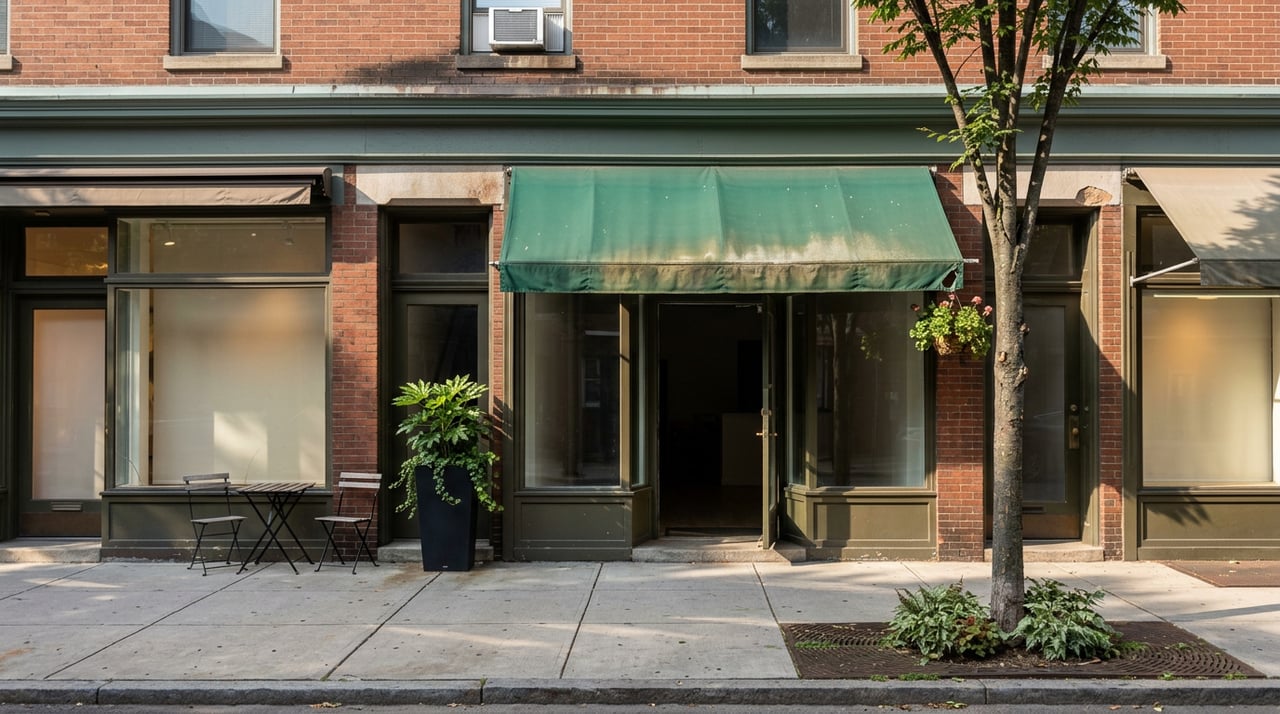
You can see the strategy playing out storefront by storefront. The Crabby Shack, a seafood spot at 613 Franklin Avenue that's been open since 2014, marked its 12th year in the neighborhood this month with a block party outside the restaurant, timed to land during the same stretch of Saturdays. A few blocks north, Nacha Focaccia opened this spring at 800 Franklin Avenue, just north of Eastern Parkway, serving vegan focaccia and sandwiches from a menu that deliberately doesn't advertise itself as plant-based. And over on Kingston Avenue, a new Hummus Bar location took over a longtime flower shop's storefront at 325 Kingston, adding another kosher option to a stretch of the neighborhood that's been asking for later hours and more sit-down space.
None of these openings needed Open Streets to happen. But all of them benefit from a calendar that keeps handing Franklin Avenue and its side streets a reason for people to be walking instead of driving through.
What's still ahead before Labor Day
The stretch between now and September 7 isn't finished stacking events. Here's what's left on the calendar as of this week:
- August 29 — the next likely Franklin Avenue Open Streets Saturday, assuming the every-other-week cadence holds through the fall
- September 7 — the West Indian American Day Parade, stepping off at 11 a.m. and running along Eastern Parkway from Utica Avenue to Grand Army Plaza
- Pre-dawn, September 7 — J'Ouvert, the mud, paint, and steel-pan procession that historically kicks off somewhere between 4 and 6 in the morning, well before the main parade route opens
If you've lived through a Labor Day in Crown Heights before, you already know the practical shape of the day: in past years, NYPD has closed Eastern Parkway to vehicle traffic by 6 a.m. and kept it closed until the parade wraps in the evening. This year's specific side-street closures haven't been published yet, but the parade's scale hasn't changed. What's different this year is that the parade isn't landing as a single disruptive Monday dropped into an otherwise ordinary August. It's the capstone of a month that's already had a Caribbean-themed museum night, a 5K, a children's festival, and multiple Saturdays of a car-free Franklin Avenue building the habit of treating this corridor as a destination rather than a route through.
A neighborhood coordinating with itself
None of the organizations behind this stretch of programming coordinated with each other on a shared calendar. The Brooklyn Children's Museum runs its own event schedule. The Franklin Avenue Merchants Association negotiates its Open Streets dates with the city separately. The West Indian American Day Carnival Association has been planning Labor Day since long before any of this year's Open Streets Saturdays were confirmed. What they've landed on, without meaning to, is a neighborhood where the last three weeks of August and the first week of September function as one continuous season rather than a handful of disconnected dates.
For anyone who already calls Crown Heights home, that's the useful thing to know walking into this stretch: the closures on Franklin Avenue aren't a random inconvenience, and the parade isn't an isolated event dropped into an otherwise quiet month. They're the same push, coming from different directions, at a moment when the corridor's small businesses need every one of those pushes to land.
If you're thinking about what a stretch like this means for property values, foot traffic patterns, or the long-term health of a commercial corridor you're invested in, that's a conversation worth having with someone who watches this neighborhood closely. The Martinez Team works Crown Heights block by block, and we're always glad to talk through what we're seeing on the ground. Request a Consultation whenever you're ready.